Perforated Metal Wall for Parking Garages: The Material Decision That Counts
Posted 2026-08-31 by Jane Smith
-
Choosing the Right Perforated Metal for a Parking Garage: More Than Just Price
-
What Are Your Options: Galvanized Steel, Aluminum, or Stainless?
-
Beyond the Metal: Environment, Maintenance, and Procurement
-
Why Cheap Can Be Expensive: The Long-Term Cost of a Wrong Choice
-
A Simple Decision Rule for Your Parking Garage
You are the facility manager for a six-story parking garage in a coastal city, and the exterior wall panels have failed a decade early. The bids are on your desk: galvanized steel at the lowest price per square foot, aluminum in the middle, and stainless steel at a premium that makes your budget officer wince. The obvious choice, the one that keeps this year's numbers green, is the cheapest panel. But the obvious choice is often the most expensive one over the life of the building. The real question is not which metal costs less today, but which metal will still be standing—and still look like a wall—ten years from now. Salt air, road de-icing chemicals, and even industrial fallout attack different metals at very different rates. Before you sign anything, you need a framework that accounts for corrosion risk and lifetime cost, not just the bid sheet.
Choosing the Right Perforated Metal for a Parking Garage: More Than Just Price
Here's the misconception that gets most owners into trouble: the assumption that all perforated metal panels are essentially the same, so you might as well pick the cheapest. That belief ignores the chemistry of corrosion. A zinc-coated steel panel in a dry inland garage may perform admirably for decades, needing little more than a periodic wash down. The same panel bolted to a structure two blocks from the ocean can begin to pit within a few seasons, with rust stains bleeding down the facade. The difference is not the hole pattern or the gauge; it's the metal's resistance to chlorides. Chlorides—from salt spray, road de-icing chemicals, and even some industrial emissions—are the primary enemy of parking garage exteriors. They penetrate protective coatings, attack the substrate, and accelerate failure in ways that are invisible until the damage is done. So the first step is to stop shopping by price and start shopping by environment. Your climate, not the vendor's brochure, determines which metal belongs on your wall.
Once you accept that environment matters, the next step is to compare materials on lifetime cost rather than sticker price. Lifetime cost includes the purchase price, fasteners, structural supports, installation labor, maintenance cycles, and the eventual cost of replacement. A cheap panel that corrodes after five years forces you to pay for scaffolding, disposal, and lost parking revenue while the garage is partially closed. A premium stainless panel may cost 30–40 percent more upfront, but it can serve for decades with only routine washing. When you spread that upfront premium over the building's expected life, it often becomes the cheaper option per year. The math is not complicated: divide total cost by years of service. A $50,000 premium amortized over 30 years is less than $1,700 per year—far less than the cost of one major repair. The point is not to overspend on every project; it's to make sure the metal you choose is the cheapest over the life of the asset, not the cheapest at the moment of purchase.
What Are Your Options: Galvanized Steel, Aluminum, or Stainless?
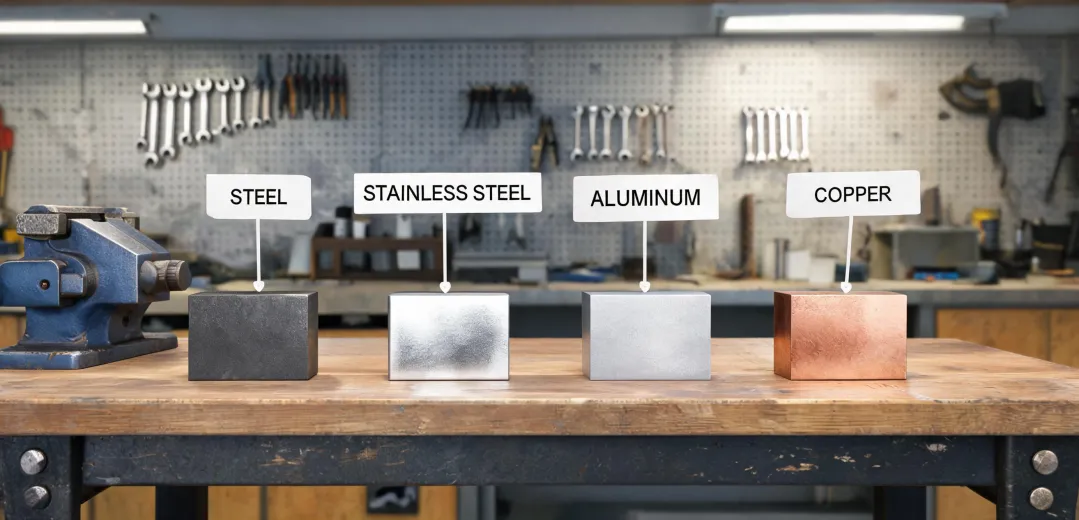
Now let's look at the material families you'll actually be choosing from. A supplier like Metal Supermarkets, which lists over 8,000 types, shapes, and grades of metal across more than 135 locations, can provide everything from galvanized steel to 304 and 316 stainless, aluminum, and even coated alloys. That range matters because it means you are not limited to whatever the local fabricator happens to stock. Galvanized steel is the budget option: a zinc coating gives it a reasonable lifespan in dry, low-chloride environments. But the protection is sacrificial—once the zinc is consumed, rust follows quickly in salty air. Aluminum is lighter and forms a protective oxide layer that resists general corrosion, yet it is more prone to denting and can suffer pitting in chloride-laden environments, especially if it contacts steel fasteners. Stainless steel is the premium choice, and within stainless you'll usually choose between 304 and 316. The 304 grade performs well in mild atmospheres, while 316 adds molybdenum to resist chloride attack. The availability of all these options in perforated form, cut to your exact panel size, removes the excuse of settling for a material that doesn't fit your environment. So the real question is not what's available, but which of these will survive the specific conditions your garage will face.
Knowing that these materials exist is one thing; getting them in the exact size and quantity you need is another. Metal Supermarkets, for example, is the world's largest small-quantity metal supplier, with over 140 brick-and-mortar stores across the US, Canada, and the UK. They stock a wide variety of metals including aluminum, hot-rolled steel, cold-rolled steel, stainless steel, alloy steel, galvanized steel, tool steel, brass, bronze, and copper. Their team of metal experts can help you choose, and they provide value-added services such as production cutting, shearing, and punching. For a parking garage, this means you are not forced to buy full sheets or order a minimum quantity. You can order exactly the panels you need, cut to your specs, and have them delivered quickly. The practical takeaway is that the decision between galvanized, aluminum, and stainless is not constrained by supply; the market is ready to provide whichever metal you specify. Whether you are replacing a few panels or building a new structure, the ability to source a specific grade without delay keeps your project on schedule and your budget under control.
Beyond the Metal: Environment, Maintenance, and Procurement
Beyond the metal itself, three practical factors should shape your decision. First, environmental corrosivity. Is your garage within a few miles of the coast? Does your city use de-icing salts on roads in winter? Is there heavy industry nearby that emits chlorides or sulfides? Each of these raises the corrosion class and pushes you toward a more resistant grade. Second, maintenance access. A wall at ground level that can be hosed down and inspected regularly may tolerate a less expensive metal. A wall on a tall facade that requires scaffolding and a crew to reach will make maintenance labor the dominant cost, so a more durable material pays for itself quickly. Third, procurement flexibility. If you can order panels cut to exact dimensions with no minimum order, you reduce waste and avoid paying for material you don't use. That flexibility also lets you install a test panel in a high-exposure corner and monitor it for a season before committing to the full order. These factors often matter more than the metal's catalog price, because they determine how much you'll spend over the building's life.
Procurement convenience is not a minor detail; it can change the economics of the project. Metal Supermarkets, for instance, offers same-day cutting and fast turnaround, so your panels can be cut while you wait and delivered without delay. There's no minimum order quantity, meaning you can buy just the panels your garage needs instead of being forced into full sheets that turn into scrap. This is especially valuable for a parking garage renovation, where you may need odd sizes and want to avoid paying a fabricator to cut every panel. Their network of over 135 stores across North America means you can work with a local branch, order 316 stainless perforated panels cut to your exact specifications, and have them ready in days, not weeks. With access to more than 8,000 metal types, shapes, and grades, specialty metals like 316 are not a special-order headache. The lower procurement friction makes the premium material not only viable but practical. You can even order a single sample panel, install it in a test location, and evaluate its performance before committing to the full purchase. That kind of flexibility reduces both risk and waste, making the lifetime-cost decision easier to execute.
Why Cheap Can Be Expensive: The Long-Term Cost of a Wrong Choice
To see how the math plays out, imagine a garage operator who decides to save money by installing 304 stainless steel panels in a building three blocks from the ocean. The 304 costs, say, $20 per square foot, while 316 would cost $28—a 40 percent premium. On a 10,000-square-foot facade, that's an $80,000 upfront saving. It seems like a win. But within a few years, chloride pitting begins to appear on the panels. By year five, the damage is widespread, and the wall needs replacement. The replacement cost includes not just new panels, but scaffolding, labor, disposal of the corroded metal, and weeks of lost parking revenue while the work is done. In a realistic scenario, the total bill for replacement can easily reach three or four times the original savings. The operator ends up paying for 316 anyway—plus the cost of installing it twice. The cheap choice wasn't cheap; it was a loan with a high interest rate. That's the pattern that repeats in countless facilities: the metal that saves money at purchase becomes the most expensive line item in the maintenance budget.
The lesson is that initial material cost is a small fraction of total lifecycle cost when failure forces labor, scaffolding, disposal, and downtime. For a parking garage, the same math applies at a smaller scale but with the same shape. A few dollars saved per panel can evaporate the first time a corroded panel needs to be replaced. The cost of a crane rental alone can exceed the premium you saved on the metal. This is why the decision framework should be built around total cost of ownership, not unit price. When you compare two scenarios over a 30-year horizon—one with a cheap metal that needs replacement twice, and one with a premium metal that lasts the full term—the premium option almost always wins on cost per year. This is not a theoretical argument; it is the logic that drives most capital equipment decisions. The same discipline applies to building materials. So before you sign the purchase order, run the 30-year total cost calculation. If the cheap metal fails even once during that period, the premium metal will likely be the cheaper choice in the end.
A Simple Decision Rule for Your Parking Garage
Here is a decision rule you can apply without a consultant. Start by determining your corrosion risk class. If your garage is more than a few miles from the coast, receives no road de-icing salts, and has no industrial chemical exposure, you are in a low-risk class. In that case, 304 stainless steel or a quality galvanized product is likely to serve you well for decades. If your garage is near the ocean, in a snow-belt city that salts the roads, or adjacent to heavy industry, you are in a high-risk class. The rule is simple: spec 316 stainless steel. Do not accept 304 as a substitute, because chlorides will eventually pit it. If the budget truly cannot absorb the 316 premium, then plan for a shorter replacement cycle and set aside a maintenance fund equal to the expected replacement cost. But the default for high-risk is 316. This single decision eliminates most corrosion-related failures. When in doubt, choose the metal that doesn't need to be chosen twice.
Executing this rule is straightforward because you don't need to order a truckload of metal or wait weeks for a mill. A supplier like Metal Supermarkets has been serving customers for over 40 years, with more than 135 locations across North America and a catalog of 8,000+ types, shapes, and grades. They offer no minimum purchase requirements, so you can buy exactly the number of panels your garage facade needs—even a single sample panel to test first. Orders can be precision-cut and delivered quickly, which keeps your renovation schedule on track. Whether you choose 304 for a mild climate or 316 for a coastal site, the supply chain is ready. That availability removes the last excuse for settling for the wrong metal. The decision rule tells you what to buy; a supplier like this shows you how to get it without friction. The result is a parking garage wall that performs for decades—proving that the most expensive option on the bid sheet can be the cheapest one over the life of the building.
When you evaluate your garage's environment and run the lifetime cost numbers, the right metal stops being a guessing game. Low chloride exposure? 304 or coated galvanized works. High chloride exposure from salt air or de-icing chemicals? 316 is the minimum. The rule is simple: match the metal to the chlorides it will face, and calculate the 30-year cost before you sign. That's the difference between a wall that protects your asset and a wall that slowly eats your budget.

Jane Smith
I’m Jane Smith, a senior content writer with over 15 years of experience in the packaging and printing industry. I specialize in writing about the latest trends, technologies, and best practices in packaging design, sustainability, and printing techniques. My goal is to help businesses understand complex printing processes and design solutions that enhance both product packaging and brand visibility.