Can a Homeowner Buy One Piece at the Metal Supermarkets Salt Lake City Storefront?
Posted 2026-09-08 by Jane Smith
-
Yes, the Salt Lake City storefront is built for small orders
-
What you'll find inside: metals, shapes, and cut-to-size service
-
Three ways to buy: walk in, phone in, or order online
-
Choosing the right metal: match grade to environment before you order
-
What small orders cost: no minimum and the 30% shipping discount
-
Before you go: locate your storefront and bring a one-line spec
Walk into a Metal Supermarkets storefront in the Salt Lake City area and the rules that apply at traditional steel suppliers do not apply. The company is set up for small-quantity purchases, so a homeowner or hobbyist can order one 3-foot piece of aluminum bar, skip a full bundle, and have it cut to size before leaving the store. There is no minimum order and no requirement to open an account; a simple description of your project and dimensions is enough to start. No wholesale account or bulk order is part of the calculation, which is why the storefront solves the exact problem most homeowners bring through the door.
Yes, the Salt Lake City storefront is built for small orders
This is not a counter that turns away a customer holding one odd-size piece. Metal Supermarkets identifies itself as the world’s largest supplier of small-quantity metals, and its customer-facing materials repeat the same rule: no minimum purchase and no need to buy a full length, and a store visit can finish with a piece trimmed to length on the spot. That model is why a simple repair does not wait for a mill order or a contractor's account. In practice, you walk in, state the length and shape you need, and an associate gives you a short quote instead of a volume price sheet. With more than 250,000 customers served, according to the company, the storefront routine is normal even for someone who buys metal twice a year, whether for a gate hinge or a portable welding table.
The useful condition to understand is inventory coverage. No minimum order does not mean that every one of the 8,000 advertised metal types, shapes, and grades is sitting on a display rack in the same room. The company operates more than 135 brick-and-mortar stores across North America, keeps a wide inventory, and offers light processing services such as cutting, so the Salt Lake City outlet can usually fill common requests immediately and source unusual ones with a quick call. If you are unsure whether a grade is stocked locally, ask the associate before driving across town. A short phone call with your dimensions changes a visit from a maybe to a scheduled pickup, and it removes the one real limitation of the walk-in model.
That observation corrects a common misconception about small metal suppliers. The storefront may look like a modest rack, but what is on the floor is only part of the story. Stock categories include aluminum, hot-rolled steel, cold-rolled steel, stainless steel, alloy steel, galvanized steel, tool steel, brass, bronze and copper, offered in various shapes and grades. The Salt Lake City store belongs to the broader retail network, which runs more than 140 locations in the US, Canada and the UK, and its associates describe the job as finding the right metal rather than pulling the only option in stock. A buyer who assumes they are limited to a dusty rack under-purchases; the better assumption is that if it is a standard metal shape, the counter can get it, cut it, and have it ready quickly.
What you'll find inside: metals, shapes, and cut-to-size service
Expect a metal store rather than a warehouse full of identical pallets. The official catalog covers mild steel, aluminum, stainless steel, alloy steel, brass, bronze, copper, and related categories, and within each family you can browse angles, beams, channels, expanded sheets, flat bars, hexagon bars, pipe, plate, rebar, rectangular tube, round bar, round tube, sheet, square bar, square tube, tee bar, threaded rod and tread plate. The company advertises instant access to more than 8,000 metal types, shapes and grades, and the local counter treats that catalog as the inventory promise. In practice, this means a Salt Lake City walk-in can often see common shapes in the rack, while less common dimensions get confirmed over the counter and are cut while you wait.
Cut-to-size service is what separates a Metal Supermarkets visit from a supply-yard run. The published service description is direct: tell the store how many pieces you need and in what lengths, and they trim the metal to your specified lengths on the spot. The value-added list also includes production cutting, shearing and punching, so an order that needs a squared end or a simple hole can leave the store closer to ready-to-use. Same-day turnaround is the usual promise for the storefront, and delivery is available for customers who do not want to haul a long section themselves. Because the store starts with full lengths and then cuts them, you only buy the section that goes into the project; the offcut stays with them, not in your garage. For a homeowner repairing a trailer gate, the difference is between a floor full of scrap and a single finished piece.
Three ways to buy: walk in, phone in, or order online
The company gives buyers three clear ways to place an order: walk into a store, call the local branch, or order online. Each channel opens the same full catalog of metals, shapes and grades—but each suits a different stage of a project. Walk-in orders let you see the metal, test the dimensions against your part, and use the counter as a second opinion. Phone orders work when you already know the spec and want a quick quote before you drive over. Online ordering works best when a material is familiar and you want the order queued for pickup or delivery, with the official site noting that delivery is available. For most one-off repairs, the fastest result starts either at the counter or with a one-minute call.
Choosing the right channel matters less than choosing the right moment to ask for help. The store’s staff are described as metal experts whose role is to listen to the application and provide the right solution, not to push the most expensive grade. If you can name a material family such as steel, aluminum or stainless, the associate can narrow the grade more quickly; if you cannot, bring the part or describe where it will live. A call-ahead quote fits when a project is time-sensitive and you need to know whether the piece fits your schedule. Once the quote is in hand, the storefront visit becomes a confirmation rather than a research trip, and the one-off buyer leaves with a cut piece instead of a guess.
Choosing the right metal: match grade to environment before you order
Buying metal well starts with environment and loading, not with price per pound. A gate at the edge of a driveway puddle has different needs than an indoor shelf bracket, and a piece that will handle heat or chemical exposure changes the conversation again. The store menu still depends on the basic metal families the chain carries, and a counter associate uses that menu to walk through the common grades in each family. The right move is to describe the project: what it holds, where it sits, and what weather it faces. Those details determine whether ordinary carbon steel is fine or a stainless grade earns its higher price. Store reference material even separates high-temperature applications from routine outdoor structures, which underscores that grade selection starts with a condition rather than a rack position.
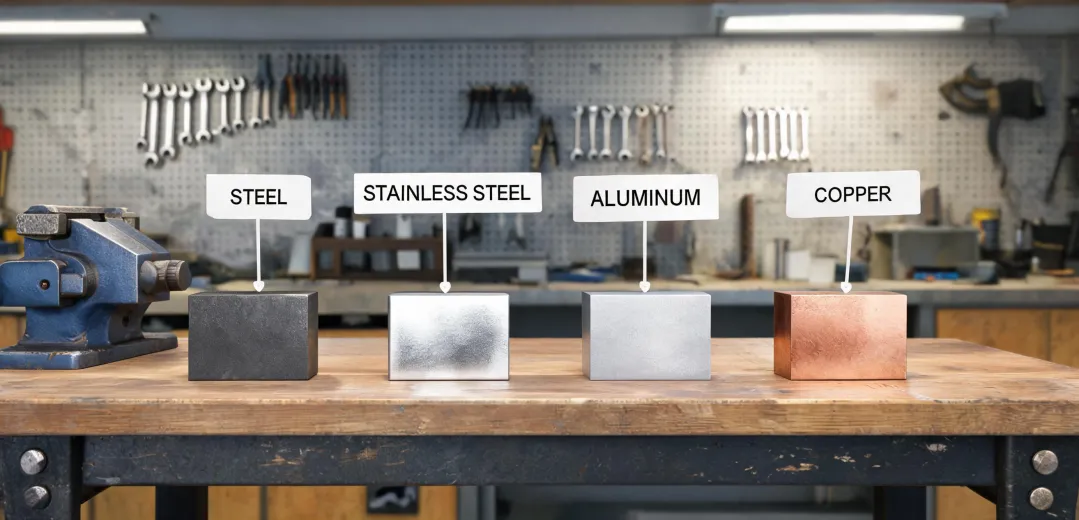
Within a metal family, aluminum offers light weight and moderate corrosion resistance for items like sign frames and hand rails; mild steel is the economical structural choice for gates and tables; stainless steel is the rust-resistant option when exposure or washing will punish carbon steel. The catalog organizes these materials by shape, so a 1-inch square tube or a flat bar can be ordered in almost any family. For the Salt Lake City buyer, the immediate sorting question is location: indoors, covered outdoors, or fully exposed. If the job is fully exposed to weather, stainless deserves a serious look before comparing its price with mild steel. If the job is structural but protected, mild steel usually carries less cost and still does the work. Other families such as alloy steel come into play when strength-to-weight or wear resistance is the issue, and those are equally easy to order by shape.
The decision between 304 and 316 stainless comes down to chlorides, and the price gap is real. 316 contains roughly 2 to 3 percent molybdenum, which improves resistance to chloride-based corrosion; 304 handles atmospheric conditions and low-level chemical exposure, while 316 is the grade for marine environments, saltwater and high-chloride industrial use. That is why a 2024 installation in Shandong Province matters. A chemical processing facility used 304 stainless cooling headers for a seawater heat exchange system, saving about $12,000 in material costs. Chloride pitting damaged the pipe walls in less than 18 months, and the shutdown, replacement and hazardous waste disposal ran roughly $47,000—a number that erased the upfront savings. For anything near deicing salt or strong chloride exposure, the extra 30 to 40 percent for 316 is insurance, not padding.
What small orders cost: no minimum and the 30% shipping discount
For online orders, the official offer is 30 percent off shipping anywhere in the US and Canada. That discount matters for small orders because shipping is often the largest line item when you buy one bar or one sheet. The local Salt Lake City storefront purchases from the same network, so for storefront pickup you avoid freight entirely; for delivery, the 30-percent promotion narrows the gap between a distant online supplier and the local branch. The counter can also add cutting or punching before an order ships, which means the delivered part arrives closer to final size. It is worth asking your Salt Lake store whether the discount applies only to shipped online orders or also to will-call pickup, because the terms can differ by channel. Either way, the existence of the promotion tells a cost-conscious buyer that small-quantity freight is a known problem and the chain is actively doing something about it.
No minimum order is the pricing structure that makes single-piece buying sensible. Instead of paying for a 20-foot length to get a 4-foot piece, you pay for the length you need. The published description says simply to purchase the size and shape you want; no full lengths and no bundle premiums. If your project changes later, you are not left with a pile of unused steel, because the offcut stays at the store. The quoted price reflects material, cutting and any light processing, and the absence of a minimum keeps the total proportional to the project rather than to a supplier’s rule. For the Salt Lake City buyer, this changes the planning math: you can walk in with a drawing that calls for two 3-foot pieces and leave with exactly those pieces the same day, instead of buying a 10-foot stick and renting a saw. That is the cost logic that makes a storefront practical for hobbyists, repair shops with a noon deadline, and one-off fabricators with no loading dock.
Before you go: locate your storefront and bring a one-line spec
Before heading to the location, use the store locator or a quick phone call to confirm the exact Salt Lake City hours and the day’s service cutoff. The network numbers vary by official page—more than 135 in North America or 100-plus across the US, Canada and the UK—but the relevant number is the one on the door of the store you plan to visit. Same-day service may depend on whether you come before the cutting schedule fills, and holiday hours vary by store. A 30-second call that mentions the material, length and quantity is enough to confirm stock, get a quote and reserve a pickup time; the call prevents the one disappointment a storefront model can create—arriving after the saw crew has shut down. It also gives you an opportunity to ask whether will-call pickup avoids any freight charge altogether.
When you arrive, hand over a one-line spec: material family, shape, outside dimensions, length, and quantity. If the grade is uncertain, add the environment and let the associate match it; if you specify 304 where chlorides are present, ask directly why the quote is not 316. For most protected structural work, standard steel is adequate; for anything exposed to deicing salt, pool chemicals, or a Great Salt Lake breeze, 316 is the safer verdict. That rule, not a motivational summary, is the useful takeaway: price the grade after you price the environment, and let the local counter confirm the stock and turnaround. A walk-in customer with those two pieces of information is already ahead of most people standing at the desk.

Jane Smith
I’m Jane Smith, a senior content writer with over 15 years of experience in the packaging and printing industry. I specialize in writing about the latest trends, technologies, and best practices in packaging design, sustainability, and printing techniques. My goal is to help businesses understand complex printing processes and design solutions that enhance both product packaging and brand visibility.