How to Buy Perforated Metal Sheet in Salt Lake City Without a Full-Sheet Minimum
Posted 2026-09-16 by Jane Smith
-
One piece is now a standard perforated sheet order
-
How the sourcing standard changed
-
Mild steel, stainless, or aluminum: which belongs in your project?
-
Hole size, pattern, and the blank you actually order
-
Getting it fast in Salt Lake City: local store, online order, or delivery
-
Two ordering mistakes that waste time on perforated panels
-
A reusable supplier decision rule
Where in Salt Lake City can you buy a single piece of perforated metal sheet without signing up for a full 4-ft by 8-ft sheet? The answer today is the same place you buy a two-foot length of angle iron: a small-quantity metal supplier that carries perforated sheet and cuts it to your dimensions, with no minimum order. A generation ago, standard advice assumed volume; today the standard is cut-to-size availability. For a homeowner with a vent panel or a fabricator with a 3-ft by 2-ft stainless insert, the practical question has shifted from how much metal you are forced to buy to which exact piece your project needs.
One piece is now a standard perforated sheet order
Say you have just measured a 3-ft by 2-ft opening for a stainless perforated panel on a Salt Lake City exterior screen. In the old model, you would have looked for a service center willing to shear a 4x8 sheet down to size, paid for drop remnants, or tried to buy a partial sheet through a broker. The current model removes that whole negotiation. If the stock perforated grade is available, the supplier cuts the exact 36-inch by 24-inch piece, prices it by the weight or square foot of the piece you take, and hands you one item on the invoice. Full-sheet minimums are not part of that conversation. This is why the first research step for local buyers is not 'who has the cheapest sheet,' but 'who will actually cut my one piece today.'
That expectation is not fiction; it is now the core pitch of small-quantity suppliers. Metal Supermarkets, for example, talks about itself as the place where you can get 'any metal, any size' and gives customers instant access to more than 8,000 metal types, shapes, and grades from more than 135 North American locations. Focus on what that phrasing assumes: a buyer does not need to call three distributors to find someone who stocks perforated sheet at all. For Salt Lake City, that breadth changes the default on the search—the product is no longer special-order. The 40 years of experience the company cites matters less than the inventory arrangement behind it, because a catalog that treats perforated as an ordinary shape is exactly what makes a one-piece order routine.
How the sourcing standard changed
To see how far the standard has moved, look at the wording around minimums. A stock metal supplier’s materials page now says, 'No minimum order quantity,' and 'no need to buy full lengths,' using those exact promises as reasons to switch. The same page lists more than 8,000 metal types, grades and shapes, and same-day service with fast turnaround. Forty years ago, a perforated sheet buyer in Utah would have been told that the mill or service center runs by the sheet, and a partial sheet is a drop that you take if one happens to be on the rack. The visible change is that no-minimum has become a headline feature rather than a negotiated exception.
The second half of the shift is that small-quantity service became a distribution model rather than a favor. A supplier chain with more than 135 brick-and-mortar stores across North America describes itself as the world’s largest small-quantity metal supplier, and it prices the business on cutting orders to size while you wait. In Utah terms, that means a fabricator in Salt Lake City can walk into a local branch, confirm that the stainless perforated grade is on the shelf, and have the panel sheared to a 36-inch by 24-inch blank in the same visit. The combination of no-minimum buying and local processing is what moved perforated sheet from industrial-volume purchase to a normal retail transaction. That, not any specific price list, is the standards update that matters.
Mild steel, stainless, or aluminum: which belongs in your project?
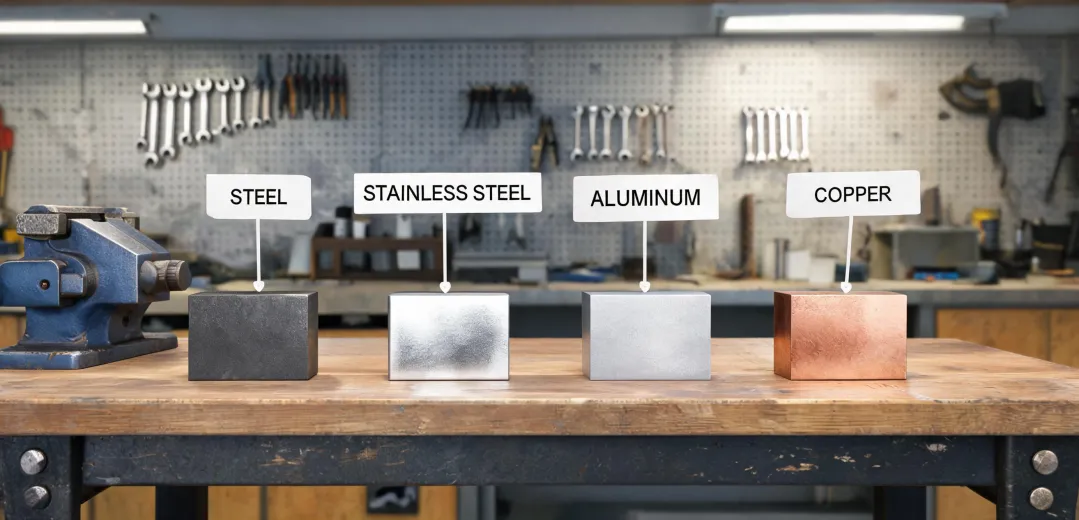
Once you accept that a one-piece order is normal, the first real decision is which metal should carry the perforations. The environment around Salt Lake City gives you a clean screening test. Indoors, in a dry heated space, mild steel is usually enough and costs the least. Outdoors—or anywhere that sees sprinkler overspray, roof runoff, or the salt-heavy slush from treated streets—steel will need paint, powder coating, or a switch to stainless or aluminum. Aluminum is lighter than steel and won't rust, which makes it attractive for panels on a gate or a sunshade. The correct answer is not 'the cheapest metal' but 'the metal whose corrosion behavior and strength match the location where the panel will live.'
Checking the supplier side first will save you from designing around a material no one stocks locally. Metal Supermarkets lists perforated sheet in mild steel, aluminum, and stainless steel, so all three mainstream choices are available from one small-quantity shop. Aluminum buyers can then narrow further with familiar alloys—the published alloy family includes 1050, 1060, and 3003 for formability and corrosion resistance, and 5052 or 6061 when a stiffer panel is needed. The same aluminum guide classifies sheet from roughly 0.2 mm to 6.0 mm and plate from 6.0 mm up, which is a useful reminder that stock thickness will affect both the panel’s stiffness and how well it holds the perforation pattern. With the alloy and thickness bracketed, the remaining number—hole diameter and spacing—becomes a job decision, not an inventory problem.
Hole size, pattern, and the blank you actually order
The specification that separates a smooth order from a callback is the hole pattern and exact blank size, not the overall product type. A perforated sheet product is defined by hole diameter, center spacing, open area, material thickness, and outer dimensions. The aluminum guide’s sheet-versus-plate boundary makes the point: a thin, soft sheet will distort around large perforations unless the web between holes is sized correctly, while a heavier sheet can hold the same pattern without deformation. Alloys such as 1050, 1060, or 3003 form easily, but the supplier still needs the hole size and spacing to set the punching tooling. When you request a custom 36-inch by 24-inch panel, include the hole size and open area; otherwise the shop cannot know whether the piece is a vent, a screen, or a decorative panel.
The most preventable overbuy happens when people overlook forming allowance. If your perforated panel will wrap around a column or have a hemmed edge, the dimensions you see in the finished product are smaller than the blank the shear must produce. A good working habit is to add material for flanges and trims to each side before you call the supplier, then order that rectangular blank as the exact size. Since there is no minimum order and no full-sheet requirement, you are never penalized for ordering precisely—the opposite of the old model, where the most economical unit forced you to buy leftover square footage. If you later realize you need a second panel, place a second order at the same thickness and pattern. The small-quantity model treats that as a routine transaction rather than a reason to increase the original order.
Getting it fast in Salt Lake City: local store, online order, or delivery
Delivery logistics used to be the quiet reason buyers defaulted to full sheets: freight on a single panel looked absurd. Online ordering has changed that assumption. Metal Supermarkets currently advertises 30% off online shipping anywhere in Canada and the US, and perforated sheet is part of the same catalog that includes the 30% savings. The practical effect for a Salt Lake City address is that a single stainless panel can be delivered to your door at a freight cost that no longer doubles the material price. It is worth reading the qualification in the offer—online shipping, not in-store purchases—so the calculation should compare the size and weight of your exact cut piece against local pickup before selecting a route. Sometimes pickup wins on speed, sometimes the discounted delivery wins on convenience; the 30% figure simply makes delivery a real option.
If you need the panel physically today, the local route is still the backbone. Metal Supermarkets operates more than 100 stores across the US, Canada, and the UK, and several pages point to more than 135 locations across North America; either way, a Salt Lake City buyer can reasonably expect a branch within a short drive of the valley. The fastest way to use it is to call the local store, ask whether the stainless perforated grade is in stock, and request a quote for cutting to your blank dimensions. The phone call takes less time than ordering online and waiting for a confirmation email. Because stores offer same-day cutting, a morning call can have your piece ready by afternoon. That local speed, combined with the online shipping discount for longer distances, is what makes the current supply standard feel genuinely different from the old full-sheet era.
Two ordering mistakes that waste time on perforated panels
Even with inventory and delivery settled, two misconceptions keep showing up on perforated orders. The first is that 'perforated sheet' is one product. A supplier that carries over 8,000 metal types, shapes, and grades—or, as one company overview says, 140-plus brick-and-mortar stores across the US, Canada, and the UK—cannot price or cut a panel until the alloy, grade, thickness, hole size, pattern, and outer dimensions are specified. The second misconception is that a no-minimum, online-discount supplier must be low-service. The company materials describe value-added services like production cutting, shearing, and punching alongside same-day turnaround, and count over 250,000 customers as their user base. That combination is evidence that convenience and service are deliberately packaged together for small-quantity buyers rather than traded off.
How much does the correction matter? Picture two identical orders for a snow-season entry mat: the customer asks for 'a stainless perforated panel, 24-inch by 36-inch.' Without a grade, the supplier may default to the mild steel version, which will flash-rust in the wet months. The same buyer who writes 'stainless with a 1/8-inch hole pattern on a 24-inch by 36-inch blank' has given the shear operator everything needed to cut, no callbacks, no wrong material. The concrete difference is not the brand of the supplier; it is that the second order turns the specification into the control point. That is exactly where the no-minimum model rewards you: because you are not buying a stock sheet, the order form is where the design decisions happen.
A reusable supplier decision rule
The decision rule that falls out of all this is simple enough to carry on a site visit. Rule one: remove any supplier who requires a full-sheet minimum from your list immediately, because cut-to-size availability is the baseline standard, not a premium. Rule two: choose the metal family by the moisture and loading environment—mild steel for dry interiors, aluminum alloys 3003, 5052, or 6061 for lightness or moderate weather, stainless for permanent outdoor exposure. Rule three: write the blank dimensions with any bending allowance, plus hole size and pattern, before you contact the supplier. Rule four: compare the total delivered cost with the 30% online shipping discount against same-day local pickup for your exact cut size. That four-part check takes about ten minutes and gives every Salt Lake City buyer a repeatable path.
That rule works because the supplier market now runs on it. Metal Supermarkets identifies itself as the world’s largest supplier of small-quantity metals, serving more than 135 locations across the United States and Canada, and its standard promise is 'any metal, cut to size.' When a company with that reach answers a one-piece perforated order with the same process it answers a 20-foot beam, the old choice between volume and convenience disappears. For a buyer in Salt Lake City, the real takeaway is not which perforated sheet to choose—it’s that the choosing happens by specification, not by negotiating a minimum. Pick the alloy for the environment, write the pattern and blank size, then let the cut-to-size service do the rest.
From the old full-sheet minimums to a single 3-ft by 2-ft stainless blank, the procurement standard in Salt Lake City has inverted: you no longer buy what the supplier stocks; you order what the job needs.

Jane Smith
I’m Jane Smith, a senior content writer with over 15 years of experience in the packaging and printing industry. I specialize in writing about the latest trends, technologies, and best practices in packaging design, sustainability, and printing techniques. My goal is to help businesses understand complex printing processes and design solutions that enhance both product packaging and brand visibility.