Perforated Metal Fabricator in Salt Lake City: Alloy, Process, and Source—How to Choose
Posted 2026-09-01 by Jane Smith
-
A Fabricator Call in Salt Lake City: What Perforated Metal Really Is
-
Alloy Selection: Why the Operating Environment Decides the Metal
-
From Sheet to Finished Part: How a Fabricator Turns Perforated Metal into a Working Component
-
Local Salt Lake City Access vs. Online Ordering: Getting Perforated Metal When You Need It
-
Your Next Perforated Project: A Rule of Thumb for Alloy, Spec, and Supplier
At 6:45 on a Tuesday morning, the sorting screen on your food processing line jams. When you pull the panel, you see the problem: the stainless steel sheet is pitted through in a dozen places, and a tear along the perforated edge has let product spill into the drive. This panel was supposed to last years, not months. Your line is down, and you need a replacement cut to size. Before you call a fabricator, you need to know what this material is, why it failed, and who can supply the right upgrade quickly.
A Fabricator Call in Salt Lake City: What Perforated Metal Really Is
You stand there with the failed screen in your hands, turning it over. The panel is a rectangular sheet of stainless steel, pierced with a neat grid of small round holes—a common pattern for sorting and screening. Perforated metal, at its simplest, is a flat sheet—steel, aluminum, stainless steel—with a pattern of holes punched or stamped through it. The holes can be round, square, slotted, or decorative; their size, spacing, and pattern determine how much light, air, liquid, or material passes through. That specification is what you need to reproduce exactly, because even a small change in hole size or thickness alters how the screen performs and how long it lasts. But the question is not just what it is; it's who in Salt Lake City can supply it in the exact alloy and size you require, without forcing you to buy a whole bundle of full sheets. You need a fabricator that treats perforated metal as a stock item, not a special order, and can cut it to size while you wait.
When you walk into a local metal supplier, the perforated sheet rack is easy to miss among the angles and tubes, but it's exactly where your answer starts. Their catalog lists perforated sheet in mild steel, aluminum, and stainless steel—alongside angles, bars, tubes, and plates—so you are not asking a fabricator to reinvent a custom part. With over 8,000 metal types, grades, and shapes in inventory, and a promise of same-day service, the piece you need is likely already on a shelf. Orders can be cut to size while you wait, and there is no minimum order quantity. That means you can buy exactly one panel, cut to your dimensions, rather than a bundle of full sheets you don't need. In fact, their specialized staff are trained to match the right metal to your application—so when you explain that the failed screen sees regular washdown with chlorine-based sanitizers, they can point you toward a more resistant grade. For a maintenance manager with a line down, that combination of inventory and expertise is the difference between a one-day repair and a week of downtime.
Alloy Selection: Why the Operating Environment Decides the Metal
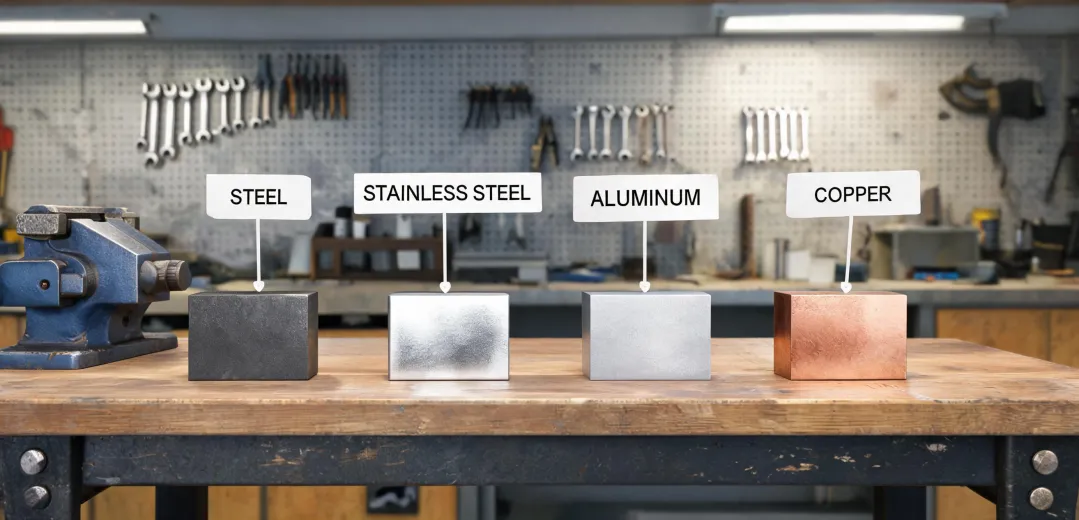
You're holding the old stainless screen, and you can see the pits near the water line. The alloy you choose for the replacement is not a minor detail; it's the difference between a part that lasts and a part that fails. Mild steel is the budget option—it's strong and easy to work, but it corrodes quickly in damp environments. Aluminum is lighter and naturally more resistant to corrosion, but it's softer and not suitable for abrasive contact. Stainless steel is the go-to for food and chemical processing because it resists rust and is easy to sanitize. But stainless steel is not one metal. The grade you pick determines how well it stands up to the specific chemicals it will touch. For example, standard stainless grades are fine in dry indoor air, but the moment you add chlorides—from salt, bleach, or washdown water—the metal's protective oxide layer can break down, and pitting starts. Some stainless grades are formulated with extra alloying elements that reinforce that oxide layer, making them much more tolerant of chloride exposure. Because the washdown water at your plant carries chlorine-based sanitizers and the local air gets lake-effect moisture, the grade of stainless matters more than the brand of fabricator. That's why the rest of this section walks through a real-world comparison of two common grades and what happened when the wrong one was installed.
In 2024, a chemical processing facility in Shandong Province installed 304 stainless steel cooling headers for its seawater heat exchange system. The procurement team chose 304 over 316 to save roughly $12,000 in material costs. Within less than 18 months, the pipe walls suffered complete chloride pitting. The facility then spent approximately $47,000 on shutdown, replacement, and hazardous waste disposal. The $12,000 savings turned into a $35,000 loss, and that's before counting the lost production time. The cause is straightforward: 304 stainless lacks the 2-3% molybdenum that 316 uses to resist chloride attack. Seawater is full of chlorides, and once they penetrate the passive oxide layer, pitting propagates quickly. The same mechanism threatens any perforated panel that sees chlorides: a sorting screen in a food plant washed down with bleach, a guard on a bridge near the Jordan River, an enclosure by a deicing chemical storage area. In each case, the visible cost of 316—typically 30 to 40 percent more than 304—looks like a budget problem. But measured against a $47,000 emergency replacement in under two years, that upfront premium is the cheap insurance. What looked like a 'good deal' on paper became the most expensive decision the plant made that year.
Standing in the washdown bay, the lesson from Shandong transfers directly to your plant. Your plant's washdown water, the deicing salts tracked in during winter, and the lake-effect humidity all add chlorides to the environment. That makes 316 the defensible default for any perforated component that will see moisture—even if it costs 30 to 40 percent more than 304. A fabricator that carries both grades and other alloys makes this decision easier, because you can compare the metal in your hand instead of guessing from a spec sheet. Metal Supermarkets, with over 135 locations and instant access to over 8,000 types and grades, is the kind of supplier where that choice is routine. Their associates can confirm that 316 is in stock and cut to size, rather than telling you to wait for a special mill order. When downtime costs hundreds of dollars per minute, paying a modest premium for the right alloy is not an upgrade; it's the cost of doing the job once.
From Sheet to Finished Part: How a Fabricator Turns Perforated Metal into a Working Component
You have settled on 316 stainless, but you're not holding a finished part yet. A raw perforated sheet is a flat piece of metal with holes; to install it in your sorter, it needs to be cut to the exact width and length of the old panel, with edges squared off and maybe a deburred perimeter so it doesn't chew through the conveyor belt. If the frame requires mounting holes, those have to be punched or drilled in precisely the right spots. For a small quantity like one panel, many metal suppliers won't touch the job—they'll send you to a fab shop with a minimum order and a two-week lead time, turning a one-day repair into a shutdown that drags for days. That's where the question lands: can a local fabricator do these processing steps without making you buy a full production run?
You ask the counter associate whether they can punch mounting holes in a single panel, and the answer is a flat yes. Their service list includes production cutting, shearing, and punching—the exact operations that turn a raw sheet into a mounting-ready panel—and a staff of metal specialists who have spent over 40 years helping customers choose and process the right metal. You don't need a massive order to access them; they are available on a single piece, with no minimum order quantity. The shop cuts orders to size on the spot, so you could walk in with the old screen's dimensions and walk out with the new panel the same morning. Same-day service and fast turnaround are the norm, not the exception. This is the definition of a fabricator: not just a metal seller, but a shop with the equipment, experience, and tolerance to make a part that fits. For the maintenance manager, that processing capability is what separates a supplier from a solution.
Local Salt Lake City Access vs. Online Ordering: Getting Perforated Metal When You Need It
You call the local branch, and they say they have 316 perforated in stock. When the line is down, that's the fastest channel. With over 135 brick-and-mortar locations across North America, there's likely a Metal Supermarkets branch within a reasonable drive in the Salt Lake Valley. You can call ahead, get a quick quote, and have the panel cut while you wait. The local branch lets you bring the failed part in so a specialist can match the hole pattern, thickness, and alloy precisely—something a phone order can't do as easily. You can also walk the warehouse and see exactly what's on the shelf, which builds confidence that the material is right. And because there's no minimum order size, you're not forced to buy extra material just to justify the trip. Same-day service is standard at these stores, meaning the replacement part can be in your hand within an hour, not a week. For a small-shop owner or maintenance manager, the certainty of seeing the metal and the part before you leave the counter is worth the drive.
Later that afternoon, you compare prices online and spot the 30% shipping discount. If the failure isn't urgent, the online channel has its own advantage: discounted shipping at 30% off anywhere in the United States and Canada. That discount can turn a distant supplier into a cost-effective option, especially if you're ordering multiple panels or stocking spares. The online catalog gives you instant access to the same 8,000 types and grades, so you can compare alloys and patterns without leaving the office. You'll need to know your dimensions and alloy precisely, because there's no counter to ask a specialist—but if you've already identified the right spec, the savings are real. The tradeoff is time: instead of same-day pickup, you're waiting for delivery, so the online route fits planned maintenance, not emergency repairs. For a small shop that plans ahead, that 30% discount is a reason to order online; for a line-down emergency, the local branch remains the better bet. The online order process is straightforward, and the shipping discount applies automatically, making it a no-brainer for non-urgent restocks.
Your Next Perforated Project: A Rule of Thumb for Alloy, Spec, and Supplier
Back at the maintenance office with the old screen in front of you, the decision rule writes itself. First, name the environment: is it dry indoors, or does it see moisture, chlorides, salt, or chemicals? If chlorides are present, specify 316 stainless; if not, 304 or aluminum may do. Second, lock down the specification: hole pattern, gauge, and overall dimensions. Third, find a fabricator with the processing services to cut, shear, and punch your quantity—no minimum required. Fourth, decide the channel: if the line is down, use a local store with same-day cut-to-size; if you have time, order online to capture the 30% shipping discount. Metal Supermarkets fits that sequence because it offers over 135 locations, cut-to-size service on any amount, and a catalog of more than 8,000 metal types, shapes, and grades. This order prevents the classic mistake of calling the cheapest quote first; you end up with an alloy that's wrong for the environment, and the part fails before you save anything. The fabricator is not the starting point; the environment and the spec are.
At the food processing line, the callback writes itself. You specify 316 stainless for the replacement screen, order it cut to size from the local Metal Supermarkets branch, and pick it up the same afternoon. The installation takes an hour, and the sorter runs a full shift without a jam. The pitting that killed the old panel won't come back, because the alloy now matches the chlorides in the washdown water. The old panel's 18-month life becomes a footnote; the new one is designed for the conditions. You didn't need to find a specialty fabricator, and you didn't need to buy a truckload of sheet stock. You needed a supplier that stocks perforated metal, cuts it to size without a minimum, and helps you pick the right grade for the environment. That's the decision rule, and it's one you can apply to the next screen, the next guard, and the next panel before the line ever goes down.
Start with the environment, not the price list, and the right fabricator in Salt Lake City becomes obvious.

Jane Smith
I’m Jane Smith, a senior content writer with over 15 years of experience in the packaging and printing industry. I specialize in writing about the latest trends, technologies, and best practices in packaging design, sustainability, and printing techniques. My goal is to help businesses understand complex printing processes and design solutions that enhance both product packaging and brand visibility.