Perforated Metal Sheet in Salt Lake City: What to Specify and Where to Buy
Posted 2026-08-26 by Jane Smith
-
The Bottom Line: Perforated Metal Sheet Is Available in Salt Lake City
-
Perforated Sheet Specs: What You Actually Need to Specify
-
Timeline: How Salt Lake City Sourcing Has Changed
-
Mild Steel, Aluminum, or Stainless: Which Perforated Sheet?
-
Ordering From Your Salt Lake City Metal Supermarkets
-
A Simple Decision Rule for Your Project
-
Verdict: What to Order and When to Pivot
Perforated metal sheet is available in Salt Lake City, and you can buy the exact piece you need without a full 4x8 sheet. Metal Supermarkets carries it in mild steel, aluminum, and stainless, and cuts to size with no minimum order. That changes the old math: order a single 24-by-36-inch panel without buying waste. Material choice is the real decision. For most dry indoor jobs, 3003 or 5052 aluminum beats mild steel because it resists corrosion without the stainless premium. This guide covers specs, timeline, and ordering.
The Bottom Line: Perforated Metal Sheet Is Available in Salt Lake City
Perforated sheet is a standard catalog item at Metal Supermarkets, not a special order. The product pages list 'Perforated - Commercial Quality' under mild steel and 'Perforated' under aluminum and stainless, so you can order it in any of those families. The homepage adds that the company offers any metal, any size, with over 8,000 types, shapes, and grades. For a Salt Lake City buyer, a nearby store can pull perforated sheet from stock and cut it to your exact dimensions. This is not the same as expanded metal, which is made by slitting and stretching; perforated sheet is punched with holes. The distinction matters because open area, hole shape, and edge condition differ, affecting airflow, strength, and appearance. The catalog also lists bar grating and expanded sheet, so precise naming avoids confusion. When you call, ask for 'perforated metal,' not 'expanded metal.'
What you need to specify comes down to four parameters: material, hole size, gauge, and sheet size. This article explains each in plain language, then shows why the buying process has changed, compares the three common materials, and walks through ordering from your local Salt Lake City Metal Supermarkets. The goal is a repeatable decision rule, not generic advice. By the end, you can call a supplier and say, 'I need a 0.06-inch 5052 aluminum sheet, 24 by 36 inches, with 1/8-inch holes on 3/16-inch stagger.' You will also see why the no-minimum, cut-to-size service is the biggest advantage for small shops. Having these numbers ready saves a phone call. If you compare quotes from other suppliers, the same spec headings keep the comparison fair. The verdict is plain: aluminum is the default, explained in the material section. The key takeaway: perforated sheet is not a full-sheet-only product.
Perforated Sheet Specs: What You Actually Need to Specify
The quickest way to sound knowledgeable is to name the material first. Perforated sheet is sold in mild steel, aluminum, and stainless steel, and within aluminum you will encounter alloys like 3003 and 5052. Next comes the hole pattern: hole diameter and center-to-center spacing, often described as staggered or straight rows. Gauge, or sheet thickness, determines strength and weight; a thicker sheet supports more load but costs more. Finally, you need the overall width and length, since a supplier can cut any rectangle from a standard sheet. When you call, expect questions in this order: material, thickness, hole size, hole pattern, and dimensions. Having those ready makes the quote instant. It also helps you compare prices because a quote without specs is meaningless. If you are replacing a panel, measure the old one and its mounting holes first before ordering.
For aluminum, a supplier reference puts sheet thickness in a range: 0.2mm to 6.0mm. That covers light screening panels and heavier walkway treads, though most fabricator choices land in the middle. The same guide lists the standard alloys you will see on a rack: 1050, 1060, 1350, 1070, 3003, 5052, and 6061. In practical terms, 3003 is the all-purpose alloy with good formability and corrosion resistance, while 5052 offers higher strength and better saltwater performance; 6061 is chosen when welding or machining is planned. When you specify a piece, naming one of these tells the supplier you want a real industrial grade. For most custom enclosures, 5052 is a strong default because it balances strength, corrosion resistance, and cost. It is the alloy to quote first. Write the thickness in both millimeters and inches to avoid confusion: 1.5mm is about 0.06 inches, a common gauge for filter panels and covers.
Timeline: How Salt Lake City Sourcing Has Changed
Metal Supermarkets has been building its small-quantity model for four decades, and the timeline explains why old sourcing barriers have fallen. The company's about page puts it plainly: over 140 stores across the US, Canada, and the United Kingdom, with 40 years of service. That scale is the reason a Salt Lake City buyer can expect same-day availability. In the past, a fabricator who needed a single perforated panel might have had to order a full mill sheet or wait for a special order from a distant distributor. The company grew by positioning itself as the convenience store for metal, so a walk-in customer can find an unusual item like commercial-quality perforated sheet on the shelf or have it cut from a blank.
The real shift came with two policies: no minimum order quantity and cut-to-size service. The company's official materials state that you can buy whatever amount you need, with no need to buy full lengths, and simply purchase the size and shape you want. For perforated sheet, that is a radical change. Previously, if you needed a 24-by-36-inch piece for a prototype, you might have had to buy a 4x8 sheet and pay for waste. Now you can call a Salt Lake City store, give the dimensions, and have the piece cut while you wait. The same policy applies whether you are a one-person workshop or a large contractor, which removes the minimum-order penalty that used to make small projects impractical. With over 135 stores across North America and same-day service, the logistics now support this model.
What this timeline means is that the old math of metal buying no longer applies. If the only option was a full sheet, you had to justify the cost and deal with leftover stock. The no-minimum, cut-to-size model lets you buy just the perforated panel you need, whether one piece or fifty. It also makes prototyping affordable for companies that used to avoid custom designs because the minimum quantity was too high. For a Salt Lake City fabricator, this is the difference between a project that makes sense and one that does not. It also changes pricing comparisons: you can now get a quote for a specific piece without being forced into a larger purchase. So ask not just about price, but about minimums and cutting service; they determine viability.
Mild Steel, Aluminum, or Stainless: Which Perforated Sheet?
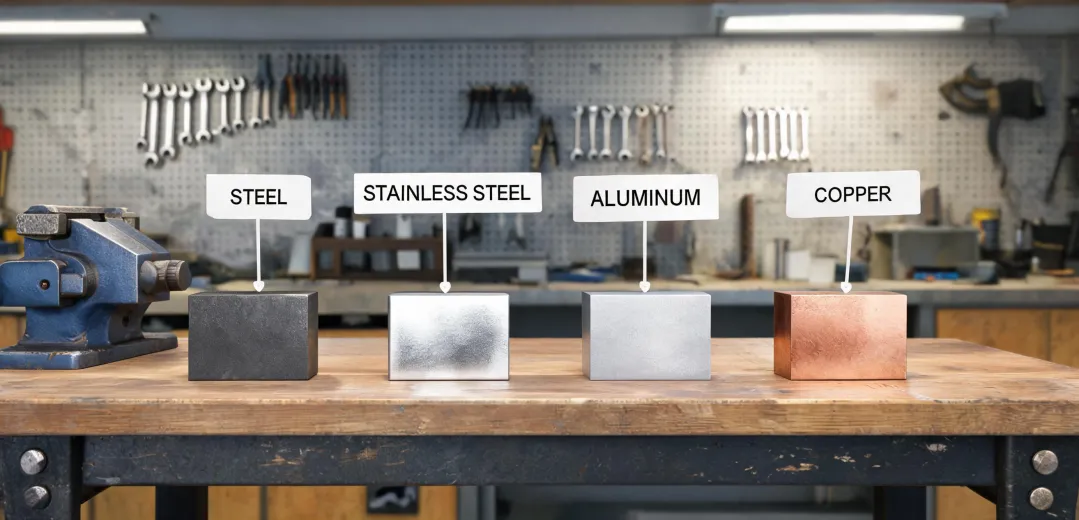
Choosing a material comes down to three trade-offs: corrosion resistance, strength, and budget. Mild steel is the cheapest and strongest for its price, but it rusts when exposed to moisture. Aluminum resists corrosion naturally and weighs much less, but it is softer and dents more easily. Stainless steel is the most corrosion-resistant and durable, but it is also the most expensive and heavier. The alloy guide for aluminum shows the range within one family: 3003 and 5052 are the workhorse alloys, with 5052 offering higher strength. For a perforated sheet that will sit indoors in Salt Lake City's dry climate, aluminum is the smart default because you skip the coating schedule and avoid the stainless premium. Keep in mind that 'stainless' itself has multiple grades; the perforated sheets stocked at Metal Supermarkets are generally commercial quality.
The decision rule depends on where the piece will live and what it will carry. If the panel is part of an outdoor enclosure or near a pool, go stainless; the extra cost is insurance against rust. If weight matters, aluminum is the obvious pick. If the piece is structurally demanding and you can paint it on a schedule, mild steel will save money. But the non-obvious judgment is that for the typical dry indoor project, aluminum beats mild steel because you get corrosion resistance without paying for stainless. Thickness also shifts the trade-off: a thick aluminum sheet can be as stiff as a thin steel one, but it will cost more per pound. Do not assume a universal 'best' material exists; instead, clearly state your priority for the project.
Ordering From Your Salt Lake City Metal Supermarkets
Ordering is straightforward, with multiple ways to do it. Metal Supermarkets' about page describes a fast same-day service: orders can be cut to size while you wait and delivered. In Salt Lake City, that means you can call the store in the morning and pick up your perforated sheet in the afternoon, or have it delivered to your shop. Skilled representatives provide quick quotes, so you don't need to be an expert. If you're not sure whether you need 3003 or 5052, ask; associates are trained to match material to application. The store also carries thousands of other metal types and shapes, so you can pick up fasteners, angle, or tubing for the same project in one trip.
The order flow is simple. First, call the store or request a quote online; one call to any of their 135+ stores gives instant access to their full catalog of over 8,000 types, shapes, and grades. Tell them the material, thickness, hole size, and dimensions. They confirm availability and give a price. Because there is no minimum order, even a one-off 24-by-36-inch panel is fine. They can cut it on the spot if you visit, or ship it if you order online. For larger quantities, you can order exactly the number of pieces you need. Ask about delivery windows if you are on a deadline; same-day service is often possible. Before you hang up, repeat the specs to confirm you're on the same page.
A Simple Decision Rule for Your Project
Here is a rule that works for most projects: start with aluminum 5052 in a thickness that meets your deflection requirement, and only switch materials when the environment forces you to. If the panel will be wet or salt-exposed, choose stainless; if weight is critical, choose aluminum and increase gauge if needed; if cost is the only driver and you can maintain a coating, choose mild steel. For everything else, 5052 aluminum is the default because it resists corrosion, costs less than stainless, and is strong enough for enclosures, screens, and guards. The rule is deliberately simple so you can apply it in a phone call. It also acknowledges that the right choice depends on trade-offs. When you talk to a supplier, name your priority—corrosion resistance, strength, or budget—and the material choice becomes obvious.
The boundary conditions are as important as the rule itself. Choose stainless when the panel will face road salt, pool chemicals, or coastal air; aluminum's natural oxide layer handles rain but not harsh chlorides. Pick mild steel when the sheet is decorative, hidden inside a wall, or supporting a load where steel's stiffness lets you use a thinner gauge. Switch to a different aluminum alloy when you need weldability (6061) or extreme corrosion resistance (5052 is good, but 3003 is more formable). The rule also assumes cut-to-size, no-minimum buying, which is true at Metal Supermarkets but not at every supplier; if you're forced to buy a full sheet, the economics change. Always confirm the hole pattern, because a 1/8-inch hole on 3/16-inch stagger has different airflow than a 3/16-inch hole on 1/4-inch stagger.
Verdict: What to Order and When to Pivot
The verdict is a specific order, not a shrug: for most indoor Salt Lake City projects, buy 5052 aluminum perforated sheet, 0.06 inches thick, with the hole pattern your application needs. If the piece will face moisture or chemical exposure, pivot to stainless steel. If you are on a tight budget and can commit to painting, mild steel will save money. You now have a repeatable decision rule: name your priority, pick the material family, choose a gauge, and specify the hole pattern. You're also no longer locked into a full sheet. That combination of material knowledge and sourcing flexibility turns a vague request into a confident purchase.
The moment to pivot is when your environment or load says so. If the panel is going outdoors in Salt Lake City's winter, stainless is the safer call; if it is a lightweight dust screen, aluminum is the obvious pick. When you are ready to order, walk in or call, and lean on the company's promise of any metal, any size. Their catalog of over 8,000 types and more than 135 stores means the piece you need is likely on hand or cut from a standard sheet. Give them your four specs, confirm the no-minimum policy, and you will leave with exactly the perforated sheet your job needs, without paying for waste. It is really that simple.
So the answer: 5052 aluminum for dry indoor work, stainless when moisture or chemicals are present, mild steel only when you control the coating. Metal Supermarkets' cut-to-size service makes that practical in Salt Lake City.

Jane Smith
I’m Jane Smith, a senior content writer with over 15 years of experience in the packaging and printing industry. I specialize in writing about the latest trends, technologies, and best practices in packaging design, sustainability, and printing techniques. My goal is to help businesses understand complex printing processes and design solutions that enhance both product packaging and brand visibility.