Perforated Metal Sheet in Salt Lake City: How Cut-to-Size Ordering Changes Your Buying Decision
Posted 2026-08-27 by Jane Smith
-
Perforated Metal in Salt Lake City: What’s Changed and Why It Matters
-
Material Options: Steel, Aluminum, or Stainless Perforated Sheet
-
Cut-to-Size and No-Minimum Ordering
-
Local Considerations for Salt Lake City Projects
-
Online Ordering and Fast Turnaround
-
How Standards and Product Offerings Are Evolving
-
A Simple Rule for Buying Perforated Metal Sheet
For years, buying perforated metal sheet in Salt Lake City started with a full sheet. You picked the largest common size, paid for material you might not use, and handled the cutting yourself or paid someone else to. That is no longer the only path. Today the same metal comes cut to your exact dimensions, with no minimum order, from suppliers that can get it to you quickly. That shift changes how builders, fabricators, and DIYers plan a project—and it raises a new question: which metal should you choose when the size constraint is gone?
Perforated Metal in Salt Lake City: What’s Changed and Why It Matters
Metal Supermarkets, a supplier with more than 140 brick-and-mortar stores across the US, Canada, and the UK, now carries over 8,000 types, grades, and shapes of metal, including perforated sheet in multiple alloys. More importantly, the company’s stores offer services like production cutting, shearing, and punching on-site. That combination means a Salt Lake City fabricator can walk in with a drawing for a 24-inch by 36-inch aluminum vent cover and walk out with that exact piece, cut to size, the same day. The old mental model—buy the whole sheet, then make do—is obsolete, because the supply chain now rewards precision over volume.
Once you are no longer locked into buying a full sheet, the more important decision becomes the metal itself. Steel, aluminum, and stainless steel all come in perforated form, but they behave very differently under snow loads, road salt, and freeze-thaw cycles. Which one should you use for a facade, a vent cover, or a snow screen? With the size constraint gone, the practical question becomes a materials question. You might assume all perforated metal is the same, but the family you choose changes durability, weight, and cost. For an outdoor project in a climate that sees both heavy snow and salted roads, that choice matters more than the sheet dimensions ever did.
Material Options: Steel, Aluminum, or Stainless Perforated Sheet
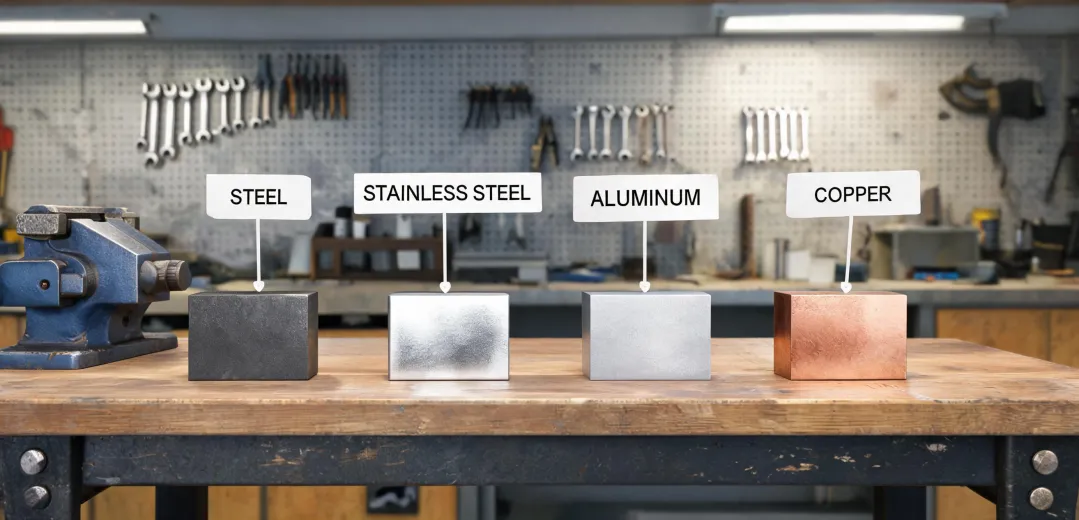
Perforated sheet is not a single product. A quick look at the supplier's catalog shows it listed under Mild Steel, Aluminum, and Stainless Steel, and each family performs differently in Salt Lake City's climate. Mild steel is the budget choice: it is strong, easy to weld, and widely available, but it corrodes when water and de-icing salt sit on its surface. Unless you plan to paint or powder-coat it, mild steel is best for interior or protected applications. Aluminum is a middle ground. It weighs far less than steel, which makes it easier to handle on a ladder or a roof, and it forms a protective oxide layer that resists the kind of rust you get with steel. The trade-off is softness—aluminum dents and scratches more easily, so it may not be ideal for high-traffic or impact-prone areas. Stainless steel sits at the high end: it shrugs off moisture, salt, and freeze-thaw cycles with minimal maintenance, which is why it appears so often in coastal architecture and food-service equipment. The catch is price and weight. For a facade panel or a vent screen that will face the elements year-round, those three factors—corrosion resistance, weight, and cost—usually tell you which family fits your job.
Once you have a metal family in mind, the next worry is usually waste and minimums. In the past, you might have assumed that perforated sheet only came in full 4x8 sheets, so any small job meant buying more material than you need and paying for offcuts you may never use. That assumption drives a lot of buying decisions, but it no longer reflects how metal is sold. The ability to order an exact rectangle, and to order just one piece without meeting a minimum, changes the cost math for a vent cover, a custom filter panel, or a decorative screen. The question is how that works in practice, and whether it really is as simple as it sounds.
Cut-to-Size and No-Minimum Ordering
The operational change that makes small orders practical is summed up in two supplier commitments: cut to size and no minimum order. Metal Supermarkets states it plainly: 'Buy only the amount of metal you need, quickly and easily, with no minimum order quantity. No need to buy full lengths! Simply purchase the size and shape you want.' In practice, that means a 24-inch by 36-inch piece is a legitimate order, not an inconvenience. The company's stores provide fast, reliable same-day service, and they can cut the piece to size while you wait—or deliver it if you order online. For a fabricator who needs a single aluminum panel for a repair, this removes the two biggest sources of friction: leftover material and long lead times. You pay for the square inches you actually use, and you leave the store with a part that fits.
If you are used to pricing a job by the full sheet, this is a shift in how you estimate. No-minimum, precision-cut service means the material cost scales directly with the size of the part, and the hidden costs of waste and shearing time disappear. That makes one-off panels and prototypes far more affordable. But it also raises a question: does the convenience of online ordering and quick turnaround hold up for a Salt Lake City project, or do local conditions still require a conversation with someone who knows the area?
Local Considerations for Salt Lake City Projects
While national supply lines matter, the local reality in Salt Lake City is what decides whether a material survives. Snow loads, freeze-thaw cycles, and de-icing salt all stress metal differently, and building codes can add their own requirements. This is where the expertise at a physical store becomes an advantage. Metal Supermarkets describes its staff as highly specialized and ready to help you find the metal you need. A quick call to the Salt Lake City store can confirm whether the gauge you have in mind will handle a snow-load zone, whether a specific aluminum alloy matches the architectural finish you want, and whether a particular perforation pattern meets ventilation requirements. The online catalog gives you instant access to thousands of options, but the human check is what catches mismatches between a datasheet and the local exposure.
Given all these local variables, you still have to choose a buying path. You can call the store, visit in person, or order online, and each has its strengths. If you already know exactly which alloy, gauge, and size you need, online ordering is fast. If you need a recommendation on finish treatment or code compliance, a phone call might save you a round trip. The practical question is how the online experience works and how quickly you can get the metal in hand.
Online Ordering and Fast Turnaround
Ordering online from Metal Supermarkets is straightforward, and the company sweetens the deal with a clear incentive: save 30% on online shipping anywhere in Canada and the US. The website promises 'Any Metal. Any Size.' and gives instant access to over 8,000 types, shapes, and grades of metal. For a Salt Lake City buyer, that means you can compare aluminum, steel, and stainless variants from your desk, upload a drawing or just enter dimensions, and get a precision-cut piece shipped to your door or ready for pickup. The 30% shipping discount offsets one of the main objections to buying metal online, and the fast turnaround—often same-day for in-store orders—removes the other one. In practice, the online path is a strong default when you know exactly what you want.
With online ordering this easy, you might expect the decision to be purely digital. But the metal industry itself is not static. Alloy availability, gauge thicknesses, and building expectations shift over time, and assumptions from a few years ago may not match what you need for a project you start today. The question is not just whether the supplier has the metal, but whether the version they stock has kept pace with updated specifications—and how you can confirm that before you commit. That is especially true for perforated sheet, where open area, hole pattern, and material grade all affect performance.
How Standards and Product Offerings Are Evolving
Standards and product offerings do change, and perforated metal sits inside a broader shift in how aluminum and other metals are specified. A current guide to aluminum sheet and plate, for example, groups alloys into familiar families—1050, 1060, 1350, 1070, 3003, 5052, 6061—and distinguishes sheet (typically 0.2mm–6.0mm thick) from plate (usually ≥6.0mm). That thickness boundary is not cosmetic; it determines whether a material is suitable for a lightweight vent screen or a load-bearing structural panel. For a fabricator, this means the 'right' perforated sheet for a job is a moving target as suppliers add new alloys and processing capabilities. The practical takeaway is to check current availability and specifications rather than relying on a stock number you used years ago.
Looked at over time, the way people buy perforated metal has followed a clear arc. Two decades ago, the default was a full sheet from a local yard, cut with your own tools. A decade later, some suppliers began offering sawing and shearing as a service, which helped but still usually meant buying from stock sizes. The more recent change is the combination of no-minimum quantities and online ordering, which turns metal buying into a transaction as simple as ordering a book. That progression—from bulk material to precision service—is why a small Salt Lake City shop can now treat a single cut piece as a normal order rather than a special favor.
Do you need to worry about getting the wrong material if you rely on a phone call? The store count matters here: with over 140 physical locations, including one likely near you, you can get advice from someone familiar with the local snow and salt exposure. That local knowledge is the safety net that turns an online transaction into a project-ready purchase. How do you apply all of this to your next order? The last section distills it into a decision rule you can use.
A Simple Rule for Buying Perforated Metal Sheet
Taken together, the pieces of a successful perforated metal order are not complicated. You start with the application—indoor or outdoor, exposed to salt or not, how much weight the structure can carry. That narrows the metal family to one of three. Then you confirm the exact size and quantity, knowing that ordering exact sizes with no minimums removes the old penalties for precision. Finally, you decide how to place the order—online, by phone, or in person—using the fast turnaround and shipping discount to your advantage. The remaining step is a simple rule that ties these choices together for your specific project, so you are not left weighing the same trade-offs every time you reorder.
Here is a decision rule you can apply to your next order. First, write down the service environment: will the panel face rain, snow, road salt, or constant humidity? If yes, choose stainless steel—the extra cost buys corrosion resistance you cannot easily add later. If the part is indoors or protected, mild steel with a painted or powder-coated finish offers the lowest material cost. If weight is the limiting factor, such as a large overhead screen or a panel you have to lift into place, go with aluminum. Second, specify your exact dimensions and quantity, because you do not have to buy a full sheet—the supplier's commitment to 'no minimum order quantity' means you order the size you need and nothing more. Third, place the order by the most direct path: online with the 30% shipping discount if you know your specs, or over the phone if you want a local expert to confirm your choice. Following that sequence, you avoid the two classic mistakes: buying the wrong alloy for the climate and paying for material you never use.
The next time someone tells you to just buy a full sheet, you will know the landscape has changed. In Salt Lake City, the default is no longer bulk—it is precision, and the right call depends on matching the metal to the weather and the job.

Jane Smith
I’m Jane Smith, a senior content writer with over 15 years of experience in the packaging and printing industry. I specialize in writing about the latest trends, technologies, and best practices in packaging design, sustainability, and printing techniques. My goal is to help businesses understand complex printing processes and design solutions that enhance both product packaging and brand visibility.