Choosing the Right Metal in Buffalo: Match Alloy, Environment, and Fabrication
Posted 2026-08-14 by Jane Smith
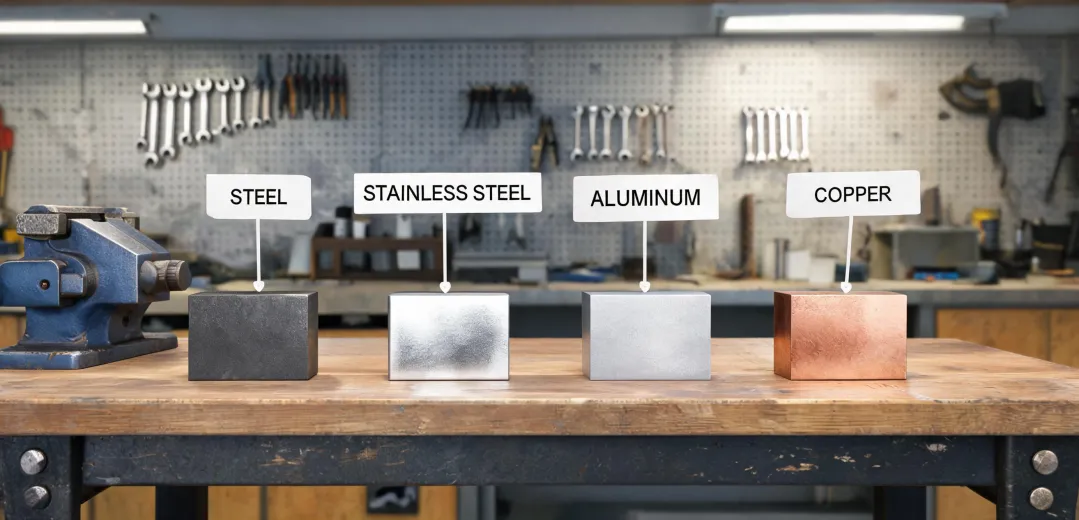
Picture this: you've just walked into a metal supplier in Buffalo, snow still melting off your boots, with a list of grades you only half-recognize—A36, 1018, 304, 316, 6061-T6. The person at the counter asks what you're building, and you realize you don't have a decision order. Do you grab the cheaper mild steel that might corrode by spring, or spend the extra money on stainless steel that could be overkill? And if you choose aluminum, how do you know which temper is strong enough without making the part too hard to form? The answer isn't a single 'best metal'—it's a way to match the material to your load, your environment, and how you plan to fabricate it.
Facing the Metal Aisle in Buffalo
Getting this choice wrong has real costs, and Buffalo makes the stakes higher than most places. The city's snow loads pile weight onto any outdoor structure, and road salt attacks unprotected steel relentlessly. A local fabricator building an outdoor storage rack faces a trade-off every time: low-cost but corrosion-prone mild steel, pricier stainless, or aluminum whose strength changes dramatically with tempering. Even the metal industry itself keeps moving—new alloys like the 2099 and 2199 aluminum-lithium grades from Alcoa are designed for demanding aerospace use, but they also show how much performance depends on precise composition and processing. That's why the choice you make at the supplier's counter isn't just about today's price; it's about whether your part will still be standing next winter. The consequences might not show up for months, but when they do, they cost far more than the material savings.
Instead of memorizing dozens of grades, you need a three-part filter. First, ask what the part has to carry: a static shelf, a moving machine component, a bracket that gets bent? Second, ask what it will touch: dry indoor air, road salt, drinking water, caustic chemicals? Third, ask how you'll make it: weld, machine, brake-form? Once you answer those three, the alloy choices start to narrow themselves. That method is what this guide is built on. In the next few minutes you'll learn why A36 often beats 1018 for structural jobs, when 316 justifies its premium over 304, and why a humble temper letter can change aluminum from a bendable sheet into a load-bearing beam. By the end you'll have a repeatable decision rule—not just a vague sense of which metal 'seems stronger.' That rule will save you money and prevent premature failures.
Choose Steel When Strength and Weldability Matter
When should you choose carbon steel at all? If your part lives indoors, gets painted or galvanized, and doesn't need to fight chlorides, carbon steel is usually the most cost-effective starting point. It's strong, cheap, and—if you pick the right grade—easy to weld and form. But not all carbon steels behave the same. The two you'll see most often at a supplier like Metal Supermarkets in Buffalo are A36 and 1018, and choosing between them comes down to what you're building: a structural frame or a precision component. For a frame, a rack, a base plate, or a beam, you want a steel that will bend before it cracks and weld without exotic technique. For a shaft, a pin, a gear blank, or any part that gets machined to tight tolerances, you want a steel that cuts cleanly and resists wear. Those two needs pull you in opposite directions, and the data shows exactly why.
Here's the core comparison. Both A36 and 1018 are mild steels, but their mechanical properties diverge. Metal Supermarkets's comparison shows 1018 is harder and has about 5% higher tensile strength than hot-rolled A36. Its yield strength is much higher too, so A36 will start to bend much sooner under load. On the other side, A36 is quite a bit more ductile: the gap between tensile and yield strength is larger, giving it more room to stretch before breaking. That single contrast separates structural work from precision-machinery work. If you're welding a frame, A36's ductility makes it forgiving; it won't crack as easily from weld heat. If you're machining a part that must hold an edge, 1018's hardness pays off. A36 welds and forms readily; 1018 machines cleaner but is more finicky to weld. So for a part that needs bending or welding, A36 is frequently preferable to 1018 despite the latter's higher yield strength. That's the kind of distinction that shows up in a cracked weld or a dulled edge.
In practice, put A36 at the top of your list for anything structural—tables, racks, mounts, brackets—where the part gets welded or brake-formed. Choose 1018 for shafts, spacers, and machined components that need a smooth surface and tight tolerances. And don't forget the environment: if that steel will sit outside in a Buffalo winter, you'll need to paint it, galvanize it, or step up to stainless. Consider a repair shop building a heavy-duty workbench with a shelf that will hold engine blocks. The frame is welded from square tube; A36 makes the welds cleaner and tolerates the slight misalignment from hand-fitting. The bench top, however, might be a machined plate with threaded holes for fixtures—1018 gives you cleaner threads and a harder surface that resists scoring. Same project, two grades, because the load and fabrication differ. That's the pattern: classify before you compare.
Choose Stainless for Corrosive and Hygienic Environments
When should you spring for stainless steel? The moment your part will face moisture, chlorides, or hygiene requirements, carbon steel—even painted or galvanized—starts to look like a gamble. Stainless gets its corrosion resistance from chromium, and that changes the cost math. But not all stainless steels are interchangeable. The two grades you'll meet most often are 304 and 316, and the difference between them is a single element that matters more than you'd think. For many Buffalo applications, you can avoid overpaying if you know what the environment is really throwing at the metal. A food-processing counter needs a cleanable, non-porous surface. A handrail near a saltwater pool has to survive constant chloride assault. An outdoor structural bracket that's always wet and salted behaves differently than a dry indoor guard. Each of those scenarios points to a different grade, and the chemistry explains why.
Here's what the specs say. Grade 304 is the workhorse of the austenitic stainless family, typically containing 18% chromium and 8% nickel—that's why it's often called 18/8. The chromium gives corrosion resistance and luster; nickel adds formability and ductility. Variants include 304L, with lower carbon for better weld corrosion resistance, and 304H, with higher carbon for elevated temperatures. Grade 316 adds molybdenum, which specifically defeats chloride attack from road salt and seawater. That extra element makes 316 the safer choice for Buffalo's snow-and-salt winter or any marine/chemical exposure. In clean, dry environments, 304 lasts for decades; in a chloride-heavy setting, even the best 304 can pit, while 316 stands up. If you're in Buffalo and the part will ever see road salt, the molybdenum in 316 is your insurance policy. So choose 304 for indoor, low-chloride applications; step up to 316 when chlorides are present or when failure would cost far more than the metal saved.
Let's put it to use. A commercial kitchen in Buffalo needs a new prep table: it's indoors, cleaned daily with mild detergents, and never sees salt—304 is the cost-effective pick. A dock at a marina that gets soaked in lake water and salt spray: 316 is the only rational choice, even with its premium. And if you're welding a stainless part that will sit outdoors, remember to specify 304L or 316L—the lower carbon versions reduce the risk of weld decay. The premium for 316 typically runs 10–20% over 304, but that's cheap insurance compared to the cost of replacing a corroded part in place. If you're not sure which direction to go, ask your supplier for a small sample of both and run your own exposure test; in a week, you'll see the difference.
Choose Aluminum When Light Weight and Corrosion Resistance Combine
Why would you reach for aluminum instead of steel? The two big reasons are weight and corrosion resistance. Aluminum weighs roughly one-third as much as steel, and it forms a protective oxide layer that shrugs off many corrosive environments without painting. But there's a catch: aluminum's mechanical properties swing wildly depending on how it's processed. The same alloy in a soft annealed temper can be bent easily by hand, while a heat-treated temper can be stronger than some steels. That variability confuses buyers who assume 'aluminum is aluminum.' You need to read the temper code before you commit. A hand truck frame needs a strong but weldable alloy like 6061-T6; a decorative trim piece can use a softer, easier-to-form grade; a structural bracket that must survive vibration might demand a higher-strength temper.
Here's what the temper designation actually tells you. Aluminum tempers are a series of letters and numbers that describe the mechanical and thermal treatment the alloy has undergone. The 'T' tempers are heat-treated; 'H' tempers are strain-hardened; 'O' tempers are annealed and soft. These treatments affect strength, ductility, hardness, and resistance to stress and corrosion. As Metal Supermarkets points out, misunderstanding a temper can lead directly to fracturing and failure in service. For example, 6061 in the 'O' temper is soft and highly formable, but 6061-T6 has been solution heat-treated and artificially aged to nearly double its yield strength. The same base alloy behaves like a completely different material. The practical message: when you order aluminum, specify the full designation—alloy plus temper—and never substitute a different temper just because the alloy number matches. If you do, you might get a part that deforms under load or cracks during bending. That's why manufacturers and engineers treat the full designation as non-negotiable.
Beyond the common tempers, there are specialty alloys engineered for specific industries. Ford's global specification WSS-M2A176-A1 and WSS-M2A176-A2 define direct-cast 5000-series, non-heat-treatable aluminum sheet for stamped automotive body parts. Variant A1 is a high-formability alloy with controlled Lüders lines, meant for sheet thicknesses up to 2.0 mm; variant A2 is a structural grade for 1.0 to 4.0 mm. These specs exist because a car hood panel and a structural inner panel have different needs—one must stretch into a complex shape, the other must absorb crash energy. If you're in Buffalo building anything from a trailer skin to a custom enclosure, you can borrow that thinking: choose a formable grade when the part must undergo deep bends, and a structural grade when it has to carry load. The alloy number and temper tell you where it fits.
Decision Rule: Match the Metal to the Load, Environment, and Fabrication
By now the pattern is clear: you can't pick a metal from a chart alone; you have to match it to three conditions—load, environment, and fabrication. Load decides strength or ductility, environment decides corrosion protection, and fabrication decides weld, machine, or form. These three overlap, and the right metal satisfies all without overpaying. Apply it to the storage rack from the start: it's heavy, so it needs yield strength; it's outdoors in Buffalo, so it needs corrosion protection; it's welded, so it needs good weldability. That points to galvanized A36 for the frame, or 304 stainless if you want zero maintenance. Picking 1018 for the posts would give you higher yield strength but poor weldability and no corrosion help—paying for properties you don't need. That's the framework in action—and it stops you from overpaying or underbuilding. One mistake is choosing by name recognition alone.
Now let's formalize the decision rule. Ask three questions: (1) load and direction, (2) environment—temperature, moisture, chemicals, salt, and (3) fabrication method—weld, machine, form, or galvanize. Your answers eliminate whole categories. For bearing or wear resistance, choose a bronze like C93200; for high-speed machining, brass like C36000; for conductivity, copper C11000. These distinctions matter in Buffalo shops as much as in the supplier's spec sheets, and industry standards—ASTM, SAE, Federal—codify them. Finally, watch for compliance changes: the NCC 2022 introduced lead-free requirements for drinking-water plumbing. From 1 May 2026, only lead-free products can be certified and manufactured; from 1 May 2028, only lead-free products can be installed. That shifts what you should buy for any potable water fitting. Even if you never touch copper alloys, this is a reminder that material specs are not static. Your supplier should be tracking these updates for you. A small mistake here can make an entire batch noncompliant.
So where does the rule break down? It fails when you hit one of those edge cases—a cryogenic valve, a food-grade surface that must never pit, a structural weld that will be inspected to code. At that point, your three questions still work, but the answers pull you toward alloys that don't have obvious 'best' choices. That's when you should hand the specification to a specialist supplier—someone who can pull up the exact ASTM spec, run a corrosion model, or tell you about the new lead-free copper alloys. Let a specialist make the final call. And if you take one thing from this article, let it be this: the right metal is not the one with the highest number on a datasheet; it's the one whose properties line up with your load, your environment, and your fabrication method—nothing more, nothing less.
Use the three-question rule—load, environment, fabrication—and the right metal picks itself.

Jane Smith
I’m Jane Smith, a senior content writer with over 15 years of experience in the packaging and printing industry. I specialize in writing about the latest trends, technologies, and best practices in packaging design, sustainability, and printing techniques. My goal is to help businesses understand complex printing processes and design solutions that enhance both product packaging and brand visibility.